
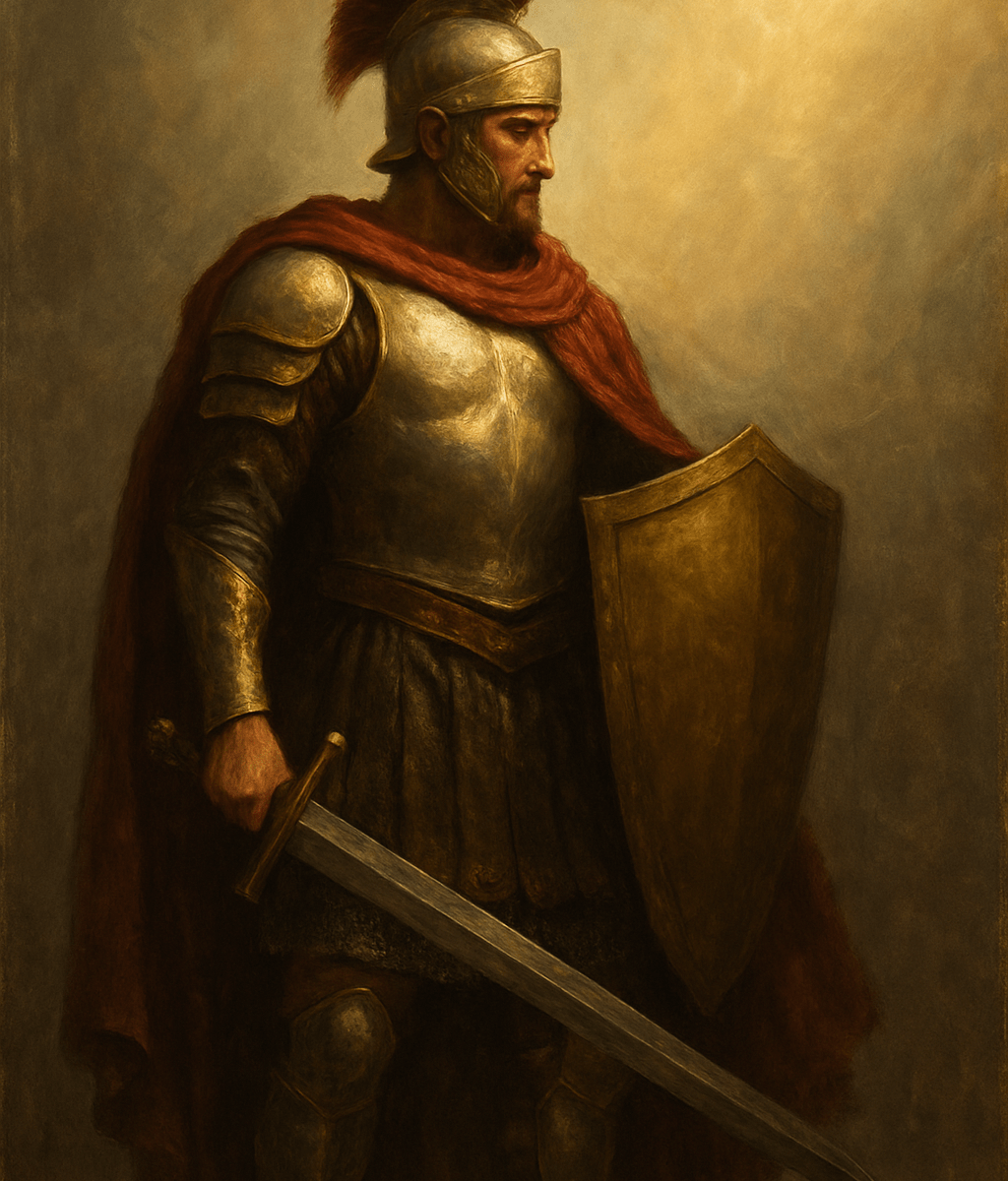
“Put on the whole armor of God, that you may be able to stand against the schemes of the devil” (Eph. 6:11).
In Ephesians 6:11, the Apostle Paul issues a solemn imperative to every believer: “Put on the whole armor of God.” This command is not a suggestion. It is a call to action, a decisive act of spiritual preparation and resolve. The Greek word Paul uses for “put on” is endysasthe, meaning “to clothe oneself, to dress.” It is a vivid, visual term, reminding us that armor is not incidental or natural attire; it must be deliberately donned. In the same way that a soldier in battle would never casually step onto the battlefield without every piece of his armor secured, the believer must not enter into the spiritual arena unprotected, unprepared, and unclothed.
This theme of putting on spiritual attire is not new in Paul’s epistle. Earlier in Ephesians 4:24, he urged the church to “put on the new self, created after the likeness of God in true righteousness and holiness.” Here, the concept of clothing oneself carries the idea of a transformative identity. We do not merely put on the armor of God; we put on Christ Himself. Romans 13:14 echoes this truth: “But put on the Lord Jesus Christ, and make no provision for the flesh, to gratify its desires.” The spiritual armor Paul speaks of is not merely a protective covering, it is Christlikeness embodied. It is the very righteousness, truth, and salvation found in Christ applied to the believer.
Yet, the call to put on the armor is not just a call to transformation; it is a call to urgent readiness. The command is given in the aorist imperative, a Greek tense that emphasizes decisive, immediate action. It is as though Paul is sounding an alarm, a battle cry to the church: “Suit up now!” The battlefield is not one of earthly terrain but of spiritual resistance. The armor is not for mere display but for battle, and the enemy is not flesh and blood but the very principalities and powers that seek to undermine the believer’s faith and obedience.
Why the urgency? Because the schemes of the devil are not dormant. The Greek word used here for “schemes” is methodías, from which we derive the English term “methods.” It suggests cunning, calculated strategies, not random acts of attack but carefully devised plans meant to deceive, discourage, and devour. The devil’s schemes are not obvious; they are subtle, insidious, and often cloaked in what appears to be reasonable, even righteous. As Richard Sibbes once noted, “Satan’s first device is to draw the soul to sin by hiding the hook of damnation under the bait of pleasure.” The schemes are seductive, and the armor is our divine safeguard.
Furthermore, we must not miss the emphasis Paul places on the entirety of the armor. It is the “whole armor” (panoplia)—not a piece here and a piece there, but the complete set of divine provision. The Greek term conveys the idea of a fully equipped soldier, lacking nothing. There is no room for partial protection. To omit even one piece is to leave a chink in the armor through which the enemy may strike. This is not a call to casual Christianity but to comprehensive readiness, a readiness clothed in Christ.
Gurnall, in his timeless work “The Christian in Complete Armour,” rightly states, “The armor is God’s, but the putting on is thine.” God supplies the armor, but it is the believer’s responsibility to put it on. We are not left defenseless in this warfare, nor are we to be passive observers. We are to actively clothe ourselves in Christ, girding ourselves with truth, shielding ourselves with faith, and standing firm in the strength of the Lord.
To put on the armor of God is to put on Christ Himself. It is to be dressed in His righteousness, to stand in His truth, to walk in His peace, and to wield His Word. It is not merely to survive the battle but to stand firm, unyielding, and resolute against every scheme and every assault of the enemy. This is the Christian’s mandate, to stand, to withstand, and, having done all, to stand firm in the full armor of God.
The call to put on the whole armor is not a call to selective protection but to full readiness. Yet how often do we step into the battle half-dressed? We leave our heads exposed to the fiery darts of doubt, anxiety, and fear because we neglect the helmet of salvation. We step forward unprotected, our feet bare, unshod with the gospel of peace, and wonder why we stumble when conflict arises. Our hearts remain vulnerable to accusation, guilt, and condemnation because the breastplate of righteousness has been set aside, and we foolishly try to defend ourselves with our own strength.
Paul’s use of the word “panoplia” is deliberate. It conveys the idea of a complete set of armor, a soldier fully equipped for combat. Every piece is essential, every piece necessary. The enemy does not attack in one way only, but in multiple ways , through lies, distortions, temptations, and accusations. Each piece of armor corresponds to a particular vulnerability: the mind, the heart, the feet, the faith. To neglect even one piece is to open oneself to assault, to provide the enemy a place to strike.
This armor, is “of God”. The armor we are called to wear is not our own but God’s. It is divine provision, forged in the fires of heaven, not crafted by human hands. Another reminder that our strength is not our own, but it is the Lord’s strength, the Lord’s armor that He has provided for us.
Every day, we face a battlefield of thoughts, temptations, and fears. Every day, doubts will assail our minds like fiery darts, questions of God’s goodness, accusations against our worth, lies that challenge our identity in Christ. Every day, we are called to put on the helmet of salvation, guarding our minds with the assurance of Christ’s finished work and His eternal promises. To leave the helmet aside is to expose our thoughts to the enemy’s deception.
Likewise, every day our hearts are at risk. The breastplate of righteousness is not a mere sentiment but a shield against the fiery accusations of the enemy. Satan will point to our failures, our sins, our shortcomings. He will accuse and condemn, seeking to wound us with guilt and shame. But the righteousness we wear is not our own, it is Christ’s righteousness imputed to us. To leave it behind is to stand unprotected, attempting to defend ourselves with our own flawed righteousness.
The feet, too, must be shod with the gospel of peace. Every step we take is a declaration that we stand firm on the unchanging gospel of Christ. When the ground trembles with uncertainty, when conflicts arise, when discouragement seeks to paralyze us, it is the firm footing of the gospel that keeps us from slipping.
John Calvin underscores this truth: “As God alone supplies us with this armor, so he alone secures the victory.” This armor is not optional. It is not to be pieced together or picked apart. Each piece is necessary, each piece divinely ordained, each piece designed to protect the believer in the heat of battle. To neglect even one piece is to open oneself to spiritual defeat. To put on the whole armor is to clothe oneself in Christ and to stand, covered by His righteousness, equipped with His truth, and shielded by His faithfulness. It is a call to stand firm, to remain unshaken, and to endure in the evil day.
“That you may be able…” (Eph. 6:11). The command to put on the armor is not an empty one; it is accompanied by a divine promise, that you may be able. The implication is that apart from putting on the whole armor of God, we are not able to stand in our strength against the schemes of the enemy. The only way, we will be able to stand firm, is by putting on the whole armor of God. Our strength to stand is not a strength born of human willpower but a strength supplied by God Himself. The Greek verb “dynamai” conveys a sense of capacity and enablement, a power granted rather than self-generated. It is the same root word from which we derive “dynamite.” This is explosive power, not in the form of physical might but in the form of divine enablement to stand firm in the midst of spiritual assault.
Paul connects this to Ephesians 6:10, “Be strong in the Lord and in the strength of His might.” The source of our strength is not our own resolve, intellect, or resources. It is the power of Christ imparted to the believer. Philippians 4:13 echoes this, “I can do all things through Him who strengthens me.” This strength is not to conquer in our own name but to stand firm in His.
The Art of Standing – Resisting, Not Retreating
Our goal is to stand. To remaining standing. “...that you may be able to stand.” Meditate on this for a minute. “To stand” (histēnai) in Ephesians 6:11 is more than simply holding one’s ground; it is a call to active resistance against spiritual attack. The Greek word conveys the sense of firmly planting oneself, of not giving ground, of enduring even when the ground shakes beneath you. This is not a passive stance. It is a posture of defiance against the enemy’s assaults, a refusal to yield even an inch to his schemes.
Paul does not call us to advance, to conquer, or to gain new territory. The ground has already been won by Christ. The call is to hold it, to stand firm and unwavering in the face of spiritual assault. The enemy seeks to intimidate, to discourage, to plant seeds of doubt. But standing is not a passive act; it is a refusal to be moved by anything other than God’s truth. It is a declaration that our faith is anchored in Christ, that we are not easily swayed by circumstances, that we will not retreat in fear or despair.
We will look at the art of standing further in our next post.
Discover more from Shorelight Devotionals
Subscribe to get the latest posts sent to your email.
 Shorelight Devotionals